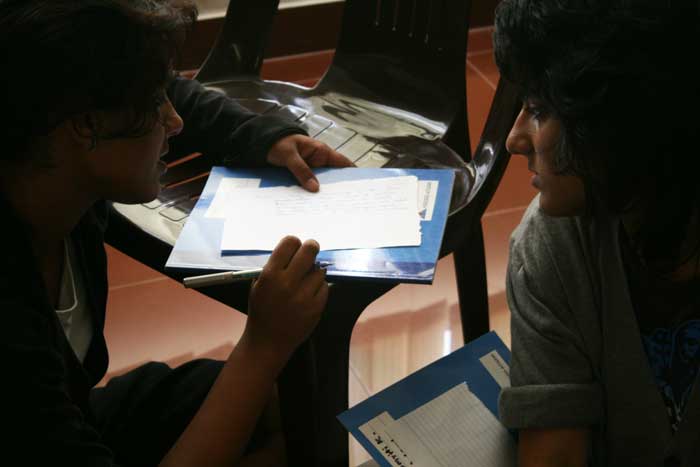
Interaction 4: Mixed group of students from Class 9 & 10; various schools.
Date: 14 August 2010
Duration: 45 mins
Number of Students: 5
Met this group through a friend, at one of their homes. Again, same process followed.
This group was extremely enthusiastic and participative. They spent a great deal of time drawing, though they repeatedly told me they can't draw. I gave them examples of what other students had done - that seemed to calm and them, and give them ideas to think metaphorically.
photographs: Akshataa Vishwanath
Showing posts with label research. Show all posts
Sunday, August 15, 2010
Tuesday, August 10, 2010
Interaction 3
Interaction 3: Students of Class 12 of Vidya Niketan School.
Date: 9 August 2010
Duration: 40 mins
Number of Students: 6
Met this bunch outside of their school, just before their extra tutions in the evening.
The atmosphere was more relaxed - the exercise was considered fun, it was like an escape from tutions. At the other two schools, it was looked at like an extra subject.
Followed the same process.
The concept of the timeline and metaphors + scale in the illustration was considered more seriously here by the students. Sharing, discussing and exchanging memories was done naturally, without me having to prompt.


Date: 9 August 2010
Duration: 40 mins
Number of Students: 6
Met this bunch outside of their school, just before their extra tutions in the evening.
The atmosphere was more relaxed - the exercise was considered fun, it was like an escape from tutions. At the other two schools, it was looked at like an extra subject.
Followed the same process.
The concept of the timeline and metaphors + scale in the illustration was considered more seriously here by the students. Sharing, discussing and exchanging memories was done naturally, without me having to prompt.


Saturday, August 7, 2010
Interaction 2: VidyaShilp
Interaction 2: Students of Class 11 at Vidyashilp Academy.
Date: 6 August 2010
Duration: 30 mins
Number of Students: 11
Followed more or less the same process as the first interaction.
The students were enthusiastic and quite responsive. As with DPS, a major inhibition exists regarding drawing and what is considered right and wrong and useful to my project.
Though the time period here was shorter than last time, I felt I was more effective. I asked questions, and helped them with metaphoric associations to translate the memory into visuals.

Date: 6 August 2010
Duration: 30 mins
Number of Students: 11
Followed more or less the same process as the first interaction.
The students were enthusiastic and quite responsive. As with DPS, a major inhibition exists regarding drawing and what is considered right and wrong and useful to my project.
Though the time period here was shorter than last time, I felt I was more effective. I asked questions, and helped them with metaphoric associations to translate the memory into visuals.

Tuesday, August 3, 2010
Interaction 1: DPS
Interaction 1: Students of Class 11 at Delhi Public School, Bangalore North.
Date: 2 August 2010
Duration: 40 mins
Number of Students: 15
Introduced myself and the project.
Divided the class into 2 groups.
Gave them a list of words to choose from. I let each student pick their own word, rather than me assigning one.
The words were all related to school and learning in some way. Some were tangible like books, lectures, teachers etc. Others were more open concepts like partiality, success, freedom, pressure etc.
It was nice to see a mix of words being picked - with immediate associations to the word as they were selecting itself.
I asked them to assign an emotion/ feeling to their word - positive or negative. Then after a brief general discussion, a question-answer session about these words, I asked them to jot down an experience when they felt that way in school or to illustrate the word they picked.
I asked them to plot all their 'chosen' experiences on a timeline as a group - and visually illustrate this on a separate sheet. I had to explain what a timeline was, and constantly coax them to draw. One girl (her word was competition) even asked me "Can I paint the picture that I made me win the 1st prize?"
I told them to keep in mind factors like location, who all were present, mood of the experience etc. The illustrations were crude, but they were able to construct simple sketches of their experiences.
Date: 2 August 2010
Duration: 40 mins
Number of Students: 15
Introduced myself and the project.
Divided the class into 2 groups.
Gave them a list of words to choose from. I let each student pick their own word, rather than me assigning one.
The words were all related to school and learning in some way. Some were tangible like books, lectures, teachers etc. Others were more open concepts like partiality, success, freedom, pressure etc.
It was nice to see a mix of words being picked - with immediate associations to the word as they were selecting itself.
I asked them to assign an emotion/ feeling to their word - positive or negative. Then after a brief general discussion, a question-answer session about these words, I asked them to jot down an experience when they felt that way in school or to illustrate the word they picked.
I asked them to plot all their 'chosen' experiences on a timeline as a group - and visually illustrate this on a separate sheet. I had to explain what a timeline was, and constantly coax them to draw. One girl (her word was competition) even asked me "Can I paint the picture that I made me win the 1st prize?"
I told them to keep in mind factors like location, who all were present, mood of the experience etc. The illustrations were crude, but they were able to construct simple sketches of their experiences.
Wednesday, July 28, 2010
Questionnaire for Students.
A brief questionnaire that I will give to the students before the interactions.
1. How does school make you feel about learning?
2. What kinds of behaviours are most rewarded in school? Is this the same kind of behaviour that is valued in the outside world?
3. When do you feel most engaged in learning?
These questions have been taken from the book previously mentioned - Wounded by School - Kirsten Olson.
Thanks.
1. How does school make you feel about learning?
2. What kinds of behaviours are most rewarded in school? Is this the same kind of behaviour that is valued in the outside world?
3. When do you feel most engaged in learning?
These questions have been taken from the book previously mentioned - Wounded by School - Kirsten Olson.
Thanks.
Structuring student interactions.

A small mind map on some things to keep in mind while
remembering.

Games/ Tools
- school related word > associated emotion > illustrate the emotion using a single colour > when was it that you felt this way?
- series of images > metaphoric > identifiable (pop culture symbols) > relating to classroom life.
Since in most of the schools, it seems like I am going to be assigned upto an hour with the students, I have decided to stick to only 2 tools, more will make the interaction confused and a mess.
I will post the list of words and images later.
Tuesday, July 27, 2010
Questionnaire for teachers

1. Comment on the general educational system.
2. How does the school handle the system (mediate between the board, students, parents and teachers)? Do you agree with these methods?
3. How could any of it be changed to better the experience for everyone involved?
4. What are the factors that motivate and demotivate the students in performing better?
5. What are the things that you think distract the students from their studies?
6. List out issues that you think most stress the students.
7. How do you see your students dealing with stress and school/ exam/ board related issues?
8. What do you advise your students in regard to coping with these issues?
9. When faced with a ‘situation’ in class (misbehavior, incomplete homework etc) how do you deal with it?
10. Do you think any alternative outlets (on part of the students) help ease these issues? (eg. Extra- curricular interests, sharing stories for venting, discussions, therapy etc.) Why and how?
Some Clarifications & Conversations.
Focus on the stories that emerge and representing those visually.
Focus on facilitating recollection of memories and creation of the visual form.
Focus not on illustration, or my illustration.
Research segment narrowed to class 11 and 12.
Interactions conducted in groups - more sharing and collective.
Deboo said "may work better to talk to larger groups first, and then follow up with a few students from each."
Roanna said "what about abstract photography to signify the things that stand out from the memories, and some sort of projections of those in the installations?"
Ameeta said "consider students' past experiences as well as their anticipation and approach for future choices. Consider the academic streams they come from and the pressures of that particular stream versus others."
Munmun said "for the interactions, do a mock one with either the aditi kids, or the foundies. It will remove the doubt that you may have right now.
for the installation, the constructed images - photography and illustration can work like a patchwork - superimposed & juxtaposed with each other, like a reconstruction of how you remember."
Focus on facilitating recollection of memories and creation of the visual form.
Focus not on illustration, or my illustration.
Research segment narrowed to class 11 and 12.
Interactions conducted in groups - more sharing and collective.
Deboo said "may work better to talk to larger groups first, and then follow up with a few students from each."
Roanna said "what about abstract photography to signify the things that stand out from the memories, and some sort of projections of those in the installations?"
Ameeta said "consider students' past experiences as well as their anticipation and approach for future choices. Consider the academic streams they come from and the pressures of that particular stream versus others."
Munmun said "for the interactions, do a mock one with either the aditi kids, or the foundies. It will remove the doubt that you may have right now.
for the installation, the constructed images - photography and illustration can work like a patchwork - superimposed & juxtaposed with each other, like a reconstruction of how you remember."
Thursday, July 22, 2010
Qualitative Research
Qualitative Research in Action by Jennifer Mason.
Excerpts from the chapter: Qualitative Interviewing: Asking, listening and interpreting.
(points mapped out. it made more sense to me this way, though it might look confused & complicated to you)

echoes what my review panel says:
- be sensitive to creating the right atmosphere
- on what basis does this interview and interviewee illuminate the social 'phenomenon' in question?
- asking definite questions makes it easier through specifics of the narration, and possibly easier to interpret.
- anticipate and discover the range of contexts in relation to the interviewee.
- ask what matters to them, what does not.
- use of a situational approach, active engagement between interviewer and interviewee.
Excerpts from the chapter: Qualitative Interviewing: Asking, listening and interpreting.
(points mapped out. it made more sense to me this way, though it might look confused & complicated to you)
echoes what my review panel says:
- be sensitive to creating the right atmosphere
- on what basis does this interview and interviewee illuminate the social 'phenomenon' in question?
- asking definite questions makes it easier through specifics of the narration, and possibly easier to interpret.
- anticipate and discover the range of contexts in relation to the interviewee.
- ask what matters to them, what does not.
- use of a situational approach, active engagement between interviewer and interviewee.
Subscribe to:
Posts (Atom)